Feature Article
October 2002
Eclectic Artists Publishing.
SIMPLY LIVING WELL
(in just 380 Square feet of space)
By Dean A. DiSandro, M.B.A. (and ex-real estate developer)
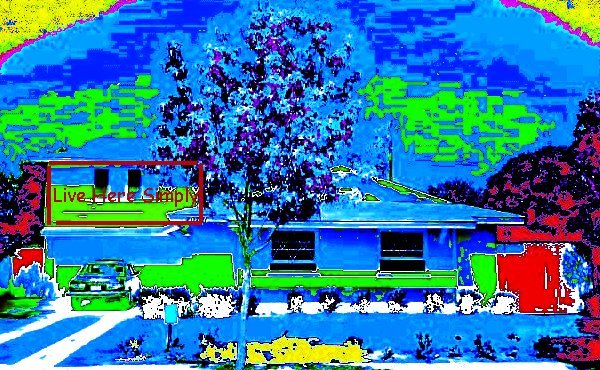
Can America ever solve its affordable housing crises? Easy question! The answer is: “Yes, we can!” But here is a tougher question: “… but will we?”
An answer to the second question is one of the great challenges facing our society, so how can I so be confident of
my first answer? Simply because I have lived within (indeed, created!) fun, functional and inexpensive housing
in one the most expensive areas in the United States (namely, Orange County, California).
Would you believe we can create housing for 2 adults and 1 child at unsubsidized rents as low as $206 per month (per home)? And, for no more than $575 per month (including taxes and insurance) the ‘tenant’ would instead become a mortgage-free owner within only 10 years?
Design, Engineering and Construction are the easy parts, the hard part is our culture. For one thing, as
conservatives will rightly claim, piggish behavior is as firmly rooted in the poor as it is among the affluent
sectors of U.S. culture… so won’t such developments inevitably devolve into public-housing slums? Of course, another
(quite related) major obstacle is our affinity for “$tuff” (first studied in accurate anecdotal form by comedian
George Carlin). Based on my own observations, it can be argued that one-third to one-half of all U.S. living
spaces are now dedicated to storage. Storage of furnishing (for cooking and dining, bedding, lounging, working,
cleaning, maintaining, etc.), clothing (especially specialty, i.e. ski, scuba and “church-going”, apparel),
automobiles, recreational items,
and the other ‘god-knows-why-the-hell-my-uncle-gave-me-that-crap-but-I-better-save-it-
for-his-annual-holiday-visit-since-I-couldn’t-dare-tell-him-to-stop-wasting-his-money-on-
mindless-consumption-because-just-giving-me-a-hug-and-his-love-is-enough’ collectibles. But I made it work, and I think many others could make it work as well… with a little help from a tolerant and open-minded culture.
Serendipity started my own project within a larger house I had purchased with my brother… and, by a series of
chance events, I soon found how happy I could be within 380 square feet (about 36 square meters) of self-contained living space (plus a similarly-sized patch of outside garden).
During the late 80’s and early 90’s I experimented (on paper) with various ideas for low-cost, community-oriented housing. Then, right at the end of my commercial/industrial development “career”, I made my bed and
I lived within it: For five years altogether, nearly 2 years of which was shared with my beloved Heidi. We lived
in ‘affordable housing’ of my own creation: Just a 19 foot by 20 foot rectangle of living space which (surprisingly) included a
full kitchen, a full toilet and bath tub/shower combo, a multimedia entertainment center, ample closet and
cupboard space, dual office desks with computer, printer and the like, music recording equipment, breakfast
nook, and even a gathering room! (As a point of reference, 380 square feet is about the same size as two SUVs
parked tightly by a Newport Beach valet.)
“But”, you ask, “how can anyone put the above list of goodies in such a tiny space?” The secret is to create a
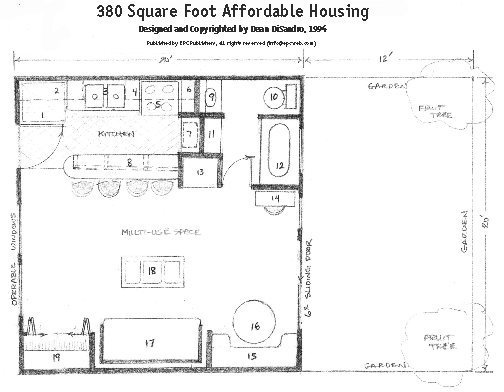
versatile common space which you can use for almost everything. When properly designed and used, space can be incredibly versatile. For example, (see floor plan illustration) we hosted dinner parties for as many as
eight (four to six being the most comfortable) by using oriental floor-pillow seating around a large coffee table
(#18). A queen-sized futon (#17) with oriental print covering served as a fashionable sofa during the day and
our bed at night. The plushly-carpeted central “multi-use” space acted as both our living room and the main
office for my corporation, and included both a 4-person kitchen buffet island/breakfast bar (#8) and dual desks
with 12 drawers of file cabinet space plus all the modern computer support appliances for 2 computers. [I used a
dual desk configuration with cabinets along the right-hand wall in place of the desk (#14) and optional dining
table (#15) with bench seat (#16) ]. The stereo/video multimedia center (#13) included generous amounts of
CD, tape, video and stationery storage above and below. In fact, under and/or over cabinets (at #2, 4, 6, 7, 8, 9,
10, 11, 13 and 19) provided this unit with nearly as much storage space as an adjacent 1,100 square foot house
built in the early 1960s! The full-sized kitchen included a standard refrigerator (#1), dual-basin stainless steel
sink (#3), range and oven (#5), microwave (#7), food pantries (#6, 7, 8) and excellent lighting over wood
parquet floors. Moreover, there was enough “extra” space to easily accommodate three guitars with stands and
amps, 2 large floor speakers, and numerous potted plants along the left-hand wall — without crowding the
normal function of the multi-user area… and this often caused me to reflect that a child’s bed/futon could just as
easily be placed there. No air conditioning was needed since the window and door locations on either side of
the home promoted great air flow when opened (regardless of its lack of ‘feng shui’ correctness). This home
also had no separate heating unit since ordinary cooking, lighting and occupancy provided adequate heat for this
compact and well-insulated space (in addition, of course, to our choices of seasonally-appropriate clothing…
although Heidi preferred the luxury of sleeping under a heating blanket in the winter). Clothing storage (#11 &
#19) may be considered cramped, especially for a ‘modern’ woman (sorry, but in my experience this stereotype
is true), but it is adequate, especially when the spaces are well-organized and the woman takes care to select a
versatile and durable wardrobe consistent with the low-consumption mentality this home encourages. Of course,
I also learned a few things that I would do differently in the future, such as installing PV Solar panels on the
south-facing roof to generate most of the home’s power needs.
Now, here is the really good news… the house was a snap to clean-up and to keep clean. Our utility bills were
tiny. Everything was easy to get to. Since my commute to work was non-existent (my office was in my home) and mundane household chores didn’t occupy my life, I had time for nearly daily bike rides of 5 – 20 miles including trips to the market,
movies, restaurants and clubs… in fact, the use of my car declined to the point where I often had trouble keeping
my car battery charged. I also had time to tend to a garden which included fruit trees, herbs, vegetables and
even row crops which provided calm recreation in addition to fresh foods. I had time to compose and practice
music, to write, to think, even to sleep! I was amazed at how much more time I seemed to have: I learned that
living small could translated into better living. I imagined entire communities of like-minded folks living within
a framework of such voluntary simplicity.
Of course, Orange County has no land zoned “R-VSL” (“Residential – voluntarily simple living”) so there was
no place to demonstrate the concept on a scale larger than my bootleg experiment (zoning ordinances are another “cultural”
obstacle). My hope is that we will be able to try such projects within some of the less densely populated areas of
California (such as San Luis Obispo County) thereby creating clusters of low-cost, high-density, strong-community housing surrounded by correspondingly available open spaces. A typical housing tract of fifty 1,500 square foot homes each occupying 5,000 square foot lots set along a maze 50-foot wide streets (plus 5 additional feet on each side of the street for sidewalks), thus blankets 10 acres of land with asphalt, autos, rooftops and cement surfaces plus a mentality of isolation, mechanization and consumption… which are then sold at enslaving prices from $250,000 up. Instead, fifty of my proposed 400 square foot homes, including 320 square foot private gardens for each, when properly arranged in checkerboard fashion along common 20 foot wide landscaped pedestrian paths with auto-accessible streets only at the perimeter, uses under 1 acre of land
(including those 50 private gardens!), leaving nine acres of open space for larger scale agriculture, recreation,
tranquility, etc.
For the economically curious, my opening figures (“as low as $206 per month to rent, no more than $575 per
month to own it outright in just 10 years”) were calculated as follows:
On the low-cost end:
(1) 400 square feet home built at a cost of $60 /sf.(which includes permits and city fees) = $24,000 (some tract
house builders claim they can build for under $50 per square foot, and our units have far fewer amenities and
even simpler construction).
(2) Presume $6.00 /sf of land ($260,000 per acre), which includes all site and infrastructure costs added to the
typical $10,000 – $50,000 per acre cost for parcels of “raw” land of 10 acres or larger (depending on the region). This
yields $5,200 for the 840 SF of land related to each unit. (Note that this per-unit land cost includes common
paths but does NOT include the cost of common ownership of the other nine acres, which is NEVER used for
housing and is therefore always available for larger-scale community agriculture, etc. The cost of this ‘raw’ land
equates to an additional $1,800 to $9,000 per unit.)
(3) $24,000 + $5,200 = $29,200 total costs per unit which, at 5% amortized over 30 years, equals $155/mo +
$31/mo taxes + $20/mo insurance = $206 per month at the low end of the assumption range where the tenants
are required to donate a fixed number of hours per month toward common area maintenance.
Using higher cost assumptions:
(1) 400 SF home at $70/sf = $28,000.
(2) 1,000 SF land at $15.00/sf (high-end retail lot prices, equivalent to $600,000 for a 10-acre parcel) = $15,000
per unit, which would include association ownership of the additional 9 acres of agricultural and open space
lands which may generate income for the association.
(3) $28,000 + $15,000 = $43,000 at 5% interest amortized over just 10 years = $454 /mo
(4) $454 principal & interest + $30/month insurance + $45/month taxes + $46/mo per unit for common area
maintenance paid to hired workers (which may include residents) = $575 per month total.
The 5% interest rate figure is, in fact, probably higher than it would need to be given the fact that only 2% – 3%
interest is now paid on most taxable savings accounts. Therefore, a tax-free savings bond program dedicated to
this affordable housing could provide all the funds necessary, probably on a local community basis.
As a side note, to ensure these units would remain in use as affordable housing, CC&Rs (covenants which would be passed along with one’s title to the home) would limit re-sale prices to the rate of general inflation, and sub-rental rates of any privately-owned unit would be pre-defined and tied to inflation as well.
Certainly, this vision bears no relation to “Cabrini Green” (as Chicago’s dismal and failed tenement housing
was called) and so a much different outcome can be predicted. In addition, using an equity-building structure,
the pride and upside of private ownership would ensure good maintenance by most occupants. And, while such compact housing may not appeal to everyone (especially those folks trapped firmly within the shop-till-you-drop mentality), it
will appeal to those folks who wish for greater community and voluntarily simple lives, not to mention those
who now use an automobile, a bridge or a box to shelter themselves and their loved ones.
Any way you slice it, those numbers are “do-able” even for single parents and even at the current “minimum
wage”. This style of living encourages tight-knitted communities, personal food gardening, lower consumption,
and less accumulation of $tuff (because there is less space to store it!). But it is also quite modern and dignified.
And, of course, I have simply presented one possible floor plan… others, perhaps slightly larger (i.e. up to 600
square feet) could provide up to two additional private rooms to accommodate larger families with adolescent
children of different sexes.
Unfortunately, this type of housing takes some profit out of the developers’ pockets, and even reduces the
income generation requirements of its occupants, both of which are heresy for the powers-that-be… and thus,
such housing would require significant political will and minor cultural adjustments.
We can do it! I know it because I’ve built the prototype. I’ve lived it. I’ve enjoyed it! We can create dignified
and affordable housing to accommodate all but the hard core sociopaths in our community… so only one question
remains: Will we?

Copyright 2002 Eclectic Properties Corporation.
Floor Plan copyright 1994 Dean DiSandro, published by Eclectic Properties Corporation.
All rights reserved. Used here by kind permission.
Poet's Park
October 2002
The Chess Move
So, here youve drawn us all to battle
and I am forced to make a move.
Youve made our lives a game by your rules,
where someone always has to lose.
Where all the Bishops act so Godly,
and the armored Knights parade.
‘Brave’ Kings behind their pawns and castles
cheer on the Queens vengeful rage.
But if I put you in a corner
youll gladly sacrafice a pawn.
I feel discussions are in order
but how can words win over arms?
When all the Bishops act so Godly
and the armored Knights parade.
‘Brave’ Kings behind their pawns and castles
cheer on the Queens masquerade.
So, now youve drawn us all to battle
and I am forced to make a move.
Youve made our lives a game by your rules
where someone always has to lose.
Go tell the preachers God is calling.
Your troops too sane to raise their arms.
The rulers, trapped within their castles,
now overcome by their own pawns!

Copyright 1995 Dean DiSandro, published and administered by Eclectic Artists Publishing.
ABOUT THE POEM
The most noble and wise philosophy of Ethics is NOT a fix set of behavioral limitations, but is instead a flexible system which responds to the demonstrated ethics of the rest of society, particularly those in power. Certainly, it is in the best interest of the powerful to sell us vaunted and rigid notions of honor and ethics — to which they themselves only pay lip service: In this way they can be sure we will bare our backs for their stealthy knives.
If we hope to defeat evil, we must recognize that we have every moral right to fight evil using the same tactics and ethics employed by those agents of evil. Thus, if the bad guys use guns and bombs then we may use guns and bombs. If they lie, then we may lie. Of course, IF we are able to defeat them without stooping as low as they do, then so much the better for us, but we are NEVER constrained to tying our own hands behind our backs while being manipulated, used and slaughtered by our adversaries. It’s an ugly reality, but it IS reality nonetheless: We are forced into battle, and we must make a move.
This poetry provides the lyrical content for a sad yet hopeful song in which the pawns someday learn who the real good guys and bad guys are, learn the collective power they have to re-make their world, turn the tools of oppression inward on their masters, and employ variable ethics in order to reclaim their freedom.
It’s your move.
Copyright 2002 Eclectic Properties Corporation.
All rights reserved.
Alter-Nation and Alter-Nation.com are Trademarks and Servicemarks of Eclectic
Properties Corporation.
Used here by kind permission.
AlterMedia
October 2002
This may be a book, a video program,
an audio program, a lecturer, poet, show or other touring artist, or any other
form of communication which is entertaining, enrichingandeducational.click here
to join now. Have an Alter-Media recommendation?Eclectic Artists Publishing. If your
suggestion is published you will receive ONE Alter-Nation Hour to be used at your
discretion.
“The Songlines”
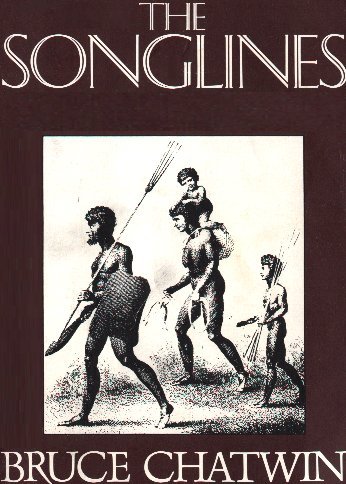
Bruce Chatwin mixes equal parts anthropology, real-life adventurer and captivating storytelling in this compelling exploration of the fascinating culture of Australia’s Aboriginals.
Without giving too much away, this book documents how Aboriginal society is woven together through a clever network of extra-familial relationships symbolized by various animal spirits. Prior to birth, each person is mystically assigned membership in a spiritual clan (sort of like a fraternity or sororiety) to which that person will belong for life. During childhood and adolescence the child learns the secret songs of his spiritual clan (which even its parents do not know or share). These songs teach the child about his spiritual ancestry, his character and personality qualities, and his destiny. It is the content of these songs which allow the adult Aboriginals to go safely on their “walkabout”, along paths they have never traveled before, sometimes across their entire continent, believing throughout the journey that they are literally singing the world they are about to encounter into existence, and (thaks to the specificity of the lyrics) always knowing what will be beyond the next hill or valley. Those songs, plus the physical and spiritual paths they describe, are that person’s songline.
The fact that these sacred paths criss-cross the continent of Australia provides the Aboriginals with an abiding rspect for the land, as well as an abiding respect for the interrelated responsibilities they each share to preserve the resources of their common land (since one never knows which features of the landscape are sacred to other spiritual clans). Thus, within this culture, private ownership of land is absurd, fences are hubris obstructions, and environmental degradation is both heretical and shamefully egocentric.
Using any metric, that is an amazing amount of power for a song to have over its singer and its society. “The Songlines” is an amazing tale: An engaging book which belongs on the shelf of every personal library; and in the heart and mind of every caring person.
Copyright 2002 Eclectic Properties Corporation.
All rights reserved.
Alter-Nation and Alter-Nation.com are Trademarks and Servicemarks of Eclectic
Properties Corporation. Used here by kind permission.