“The World’s Wasted Wealth 2”
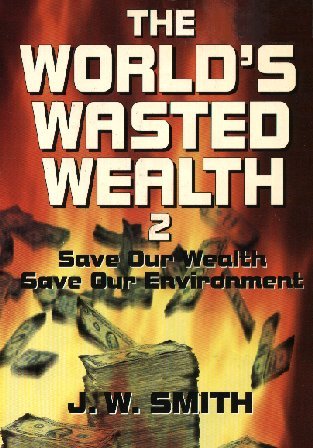
Since this book shares the same initials (“WWW”) as those associated with the recently imploded stock values of the DotCom arena, shaken investors might leap to their own conclusions regarding what “The World’s Wasted Wealth” is all about.
Put that confusion aside. This volume is a sequel to the original title (which we have not reviewed) providing superbly footnoted historical details in support of its main thesis: Human labor and social capital is purposefully wasted in order to perpetuate the inequitous rule of a privileged class; Without such waste, no one would need to work more than a few hours per week in order to provide ALL of the modern comforts; Once people had such an abundance of free time and energy they would demand significant changes in the power structure.
J.W. Smith makes his case in a compelling manner, always providing an array of examples from both history and modern era events. Starting at the Middle Ages, Smith follows the economic and political battles waged by the aristocracy against the “free men” and “free cities” to achieve control over both. From this perspective, war is always really “trade war”, driven by economics not passions or ideologies (which emotions are the private reserve of propagandists charged with whipping up the support of the masses). He also argues, just as Alter-Nation has, that the Cold War was specifically designed to cause massive amounts of waste in an effort to bankrupt the Eastern block into submission: Capitalists therefore triumphed on numerous fronts simultaneously since their strategy eliminated Socialist philosophical competition while radicially increasing the debts of nearly all the world’s nations… debt bonds held by those same Capitalists!
Smith’s current examples of massive and blatant waste cut a large swath through our economy: Insurance; Law; Transporation; Agri-Business; Finance; Health Care; Energy; and, of course, Government and Bureaucratic wastes. He argues that just 14% of the Western world’s current productive capacity is needed to provide ample goods and services for everyone on the planet, and that all of the rest of mankind’s labor and resources are essentially wasted. Moreover, war (the ongoing battle for control over production, labor and resources) repeatedly destroys much of what humanity builds, further exaserbating the waste.
This book is so well researched, annotated and argued that it often reads like a scholarly tome. In this respect it is doomed to that small readership able to focus on a series of pages which do not involve sex or celebrities. That is a pity, since Smith doesn’t just talk about what is wrong, but outlines dozens of ideas for how to set the world right.
If you want to understand not only how the world got to where it is now, but also the pathways we could take to improve things considerably, this book is a wealth of information… not a drop of it is wasted.