Michelangelo’s”Slaves”
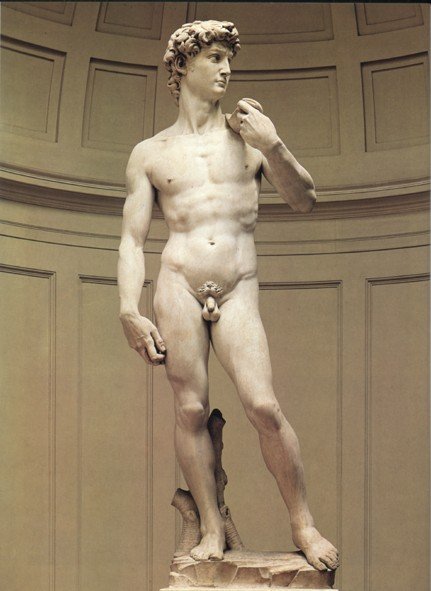
Michelangelo (circa 1500), sculptor, painter, architect and poet, is perhaps the most prolific and renowned artist of all Western history. He was also, de facto, in servitude to the Church & State powers-that-be of his era. Regardless of the self-aggrandizing motives of his patrons, Michelangelo’s genius could be directed but never contained. Just as his hand of God (on the Vatican’s Sistine Chapel ceiling) has reached across centuries to the wonderment of each new generation of enlightened observers, his scultpure of David continues to inspire awe for its craftsman’s perfection.
A significant part of his genius was his ability to “fly under the radar” of his overlords, inserting commentary regarding the religious, social and political context not only of his day but ours as well. His life and his works are a study of the human condition, particularly our spirit’s yearning to breathe freely, and his “The Slaves” series provide a particularly poignant example of his talent.
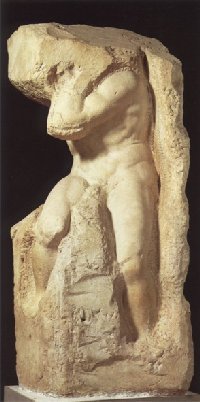
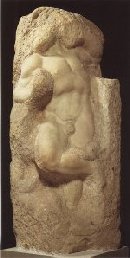
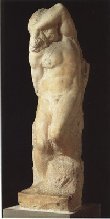
“Slaves” are comprised of six massive blocks of marble which are often referred to as “unfinished”. They are arranged (at Florence’s “Galleria dell’Accademia” museum) such that you walk down between 3 sets of pairs, at any one moment having one block on your left and one on your right, with David displayed prominently centerstage at the end of this corridor. The sequence of blocks portray the incomplete transformations of raw marble into finished objects of art, simultaneously depicting the struggle of each of the single figures trapped within the art to escape its stone prison. The first two blocks have only the beginnings of head and shoulder evident, with rough chisel and scraper marks in evidence. The next pair of blocks reveals larger proportions of body forms, seemingly in stymied motion, through a combination of finely worked surfaces and roughly worked areas, with much of the raw marble blocks still untouched. In the final pairing there is still an abundance of uncut marble, but the emrging figures are now clearly attempting to tear themselves from the stone, with many of their muscular details superbly revealed and finely polished.
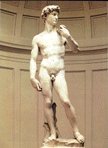
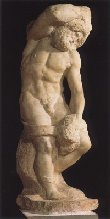
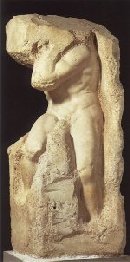
Contrasted with the exquisitely rendered David, just yards away, we are left with a multiplied sense of awe. Michelangelo has shown us the vision one must possess when starting with a tabula rasa, the skills own must possess to confront the will stone with the intentions of a lover, the wisdom one must possess to speak volumes about the human condition without uttering a sound, and the combination of imagination and courage required to leave “unfinished” the work which can never be finished.
A trip to Italy is on the dream list of many people. Perhaps now, a visit to the Slaves will be a Must-See on your list as well… or perhaps you’d prefer to start now!