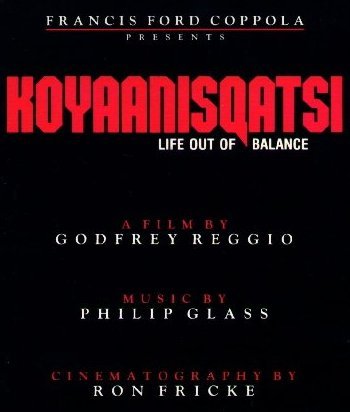
KOYAANISQATSI
(VHS videotape 1:27)
Can you imagine a film which tells a deep, far-ranging and powerfully compelling story, rich in metaphor and pogniant commentary, using only breath-taking cinematography and minimalist music (sans words) in just 87 captivating minutes?
In 1983, KOYAANISQATSI (pronounced Koy-yawn-is-kot-si) established a bold new genre for story-telling, simultaneously providing positive proof of the old saying “a picture is worth a thousand words”. With no actors, no dialogue, no voice-over narration, not even lyrical content to advance the plot, this lushly captured and wonderfully edited film manages not only to entertain, but to enlighten and inspire. At 24 frames per second, its 125,280 pictures speak volumes on an array of topics in that most universal of animal languages: Pattern Recognition.
The word KOYAANISQATSI, which is taken from the Hopi indian language, translates as “crazy life”, “life in turmoil”, “life disintegrating”, “a state of life that calls for another way of living”, or “Life out of balance” (the last definition being the producer’s choice as the film’s advertised sub-title). The time-lapse history of our planet, completed with a crescendo of modern humanity, does indeed make a compelling argument for the title’s assertion.
What Hollywood executive(s) would demonstrate his/her/their insanity by green-lighting such an unconventional (read: ri$ky) movie? Executive producer Francis Ford Coppola found the financing, Producer/Director Godfrey Reggio articulated the vision, Director of Photography / Co-Editor Ron Fricke captured the earthscapes and mined the archives, and Philip Glass provided the music… so it is not surprising that the result was cinematic genius. While the film enjoyed only modest box-office and video sales success, it lives on as a classic work of art.
As the first installment of a planned trilogy, Koyaanisqatsi is not meant to leave us feeling particularly upbeat, only stunned into silent introspection. It’s gorgeous images will mysteriously revive themselves in your memory, as surely as its noire implications will haunt you, for days, months and years. This is eye-candy and brain food you can (and should!) consume often. Although the second installment (Powaaqatsi, “Parasitic Life”) continues the genre with a more explicit focus on modern humanity, the third (Noqaaqatsi, “War-Like Life”) has yet to be financed. Lest one presume that the form has failed, Reggio and Fricke have subsequently found financing and audiences for a more upbeat full length feature, Baraka (Swahili for “Spirit”, an inspiring look at how humanity worships its god(s)), and a short nature film entitled Anima Mundi (presumably Latin for “Living World”). Each and very work is well worth the time, effort and expense and is a must for any informed library.
All in all, Koyaanisqatsi (and its siblings) provide the intelligent viewer with a quality which is too often missing from film: A fresh perspective… in fact, an incredibly transcending perspective.
In later films (e.g. Baraka) Fricke pioneered innovative technologies using computers to drive mechanized dollies and camera pan-tilt heads, thereby creating time-lapse photography tracking shots which literally allow us to witness the revolutions of our world. For the serious film buff, student or wannabe, the technical aspects alone make these films “must-sees”.
Other films in this genre which we also recommend:
Powaaqatsi
Baraka
Anima Mundi
(and the hope for the future release of) Noqaaqatsi.
The Alter-Nation Project is currently working to make both the video and book
titles mentioned above available through our $tuff pages. In the meantime, check
your local independent video rental or bookstore. To be placed on our
mailing list for notification when these titles become available for puchase
send your name and e-mail address to $tuff@alter-nation.com
with “KOYAANISQATSI” in the subject line.