BOOK TIP OF THE MONTH
Fritjof Capra: “The Tao of Physics”
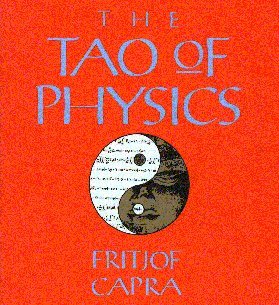 The
The
very title of physicist Fritjof Capra’s book, “The Tao of Physics”, begs the question:
“What does the study of physics have to do with the Eastern philosophical tradition
of Tao?” The surprising answer, in a nutshell, is “just about everything”.
The study of physics is arguably the most mind-blowing experience one can have
without ingesting psychedelics (although it is said that employing each, in measured
amounts and at alternate times, can have exponentially greater effects). Physics
is the fundamental science required for understanding our place in the
universe and how it works: From the exceptionally small (i.e., what lies inside
the nucleus of an atom) to the inconceivably large (i.e., what is the size of
the universe), and the inherent nature of everything in between.
Sadly, many people also believe that understanding physics is simply too far beyond
their personal intellectual abilities. Admittedly, the mathematics of physics
can be daunting. However, due to the brilliant insights and visual analogies created
by geniuses such as Albert Einstein, the basic concepts of physics (that is, most
of the really mind-blowing stuff) can be grasped by almost anyone who cares to
try.
The same can be said of Eastern philosophies such as Hinduism, Taoism, and Buddhism
which are as similar to each other as they are different from Judeo-Christian-Islamic
beliefs. A truly intriguing aspect of these ancient philosophies, however,
is how similar they are to modern, mathematically-based Western physics!
Over the past 100 years, as physicists have developed and refined the theory of
Quantum Mechanics, fascinating parallels with Taoism, Buddism, and Hinduism have
emerged… much to the surprise, wonderment and even confusion of Western scientists.
In this book, Fritjof Capra does an incredible job of summarizing the major Eastern
philosophies as well as the discoveries (and theories) of modern physics, all-the-while
intertwining the stunningly similar descriptions, conceptualizations, predictions,
and wisdoms of these seemingly unrelated areas of human thought. Using simple
visual analogies (and literally NO MATH), Capra’s style of explanation can be
grapsed by every high school level reader. In the end, we realize that while science,
philosophy and spirituality employ radically different methodologies, each is
attempting to answer the same fundamental questions of who we are, how did we
get here, what it is all about. If you have ever considered these questions yourself,
and are curious to know the best consensus thinking of brilliant minds for the
past several millenia, then you owe it to yourself to read “The Tao of Physics”.
(As a side note, the interrelations between physics and Eastern philosophy are
not creations of Capra’s fertile imagination: Dozens of excellent books by notable
scientists and intellectuals have been written on the topic. Capra’s “The Tao
of Physics” and his film “Mindwalk” are simply two of the most intellectually
accessible works on the topic.)
Before you dismiss this recommendation as so much “New Age” malarkey (as borrowed
bits of Eastern philosophies are often labeled in the West), consider the phenomenal
TANGIBLE output of modern physics. Remember, Physics is the science which overcame
the various legends of creation, and showed us our actual place in time and space:
A globe revolving on its axis and orbiting a sun which in turn orbits its galaxy
which (along with all the other galaxies) is flying away from the center of a
universe which exploded into being some 10 billion years ago. Physics is the science
which helps us understand Electricity and Magnetism, giving us computers and guidance
systems. Physics is the science which helps us understand light, and thus fiber-optics.
Physics is the science which gave us the ability to invent airplanes and rockets,
and thus telecommunications satellites and space exploration. For better or worse,
Physics also gave us the ability to release unbelievable amounts of raw energy
from small chunks of rock via the deceptively simple relationship “E = mc“,
thus proving that everything we see around us is really just bundles of pure energy:
Nothing is solid; Nothing is still; Everything is interconnected at every level.
If that sounds a lot like Eastern mysticism or “New Age” thinking then you are
already starting to get the point: As Bob Dylan sang, “There’s something going
on here but you don’t know what it is, do you, Mr. Jones?”