MUSICAL BONUS
Marillion – “Misplaced Childhood”
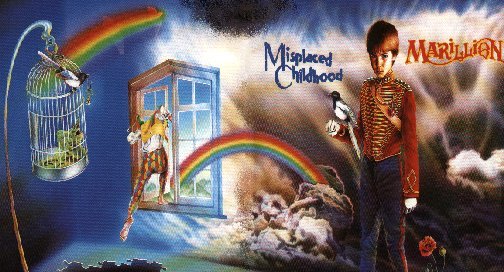
In the grand (yet grossly under-utilized) tradition of rock opera, this now-defunct Scottish band specialized in concept albums. Misplaced Childhood is the finest example from their several excellent musicals… so if you like this one, try all the others.
From Pink Floyd to Alice Cooper, Genesis, and The Who, the rock opera is largely a relic of a more artistic, “early FM”, musical world. With massive corporations now in control of nearly all distribution, publishing and promotion (i.e., radio and TV) channels, popular music has been largely dumbed down to inconsequential soundbytes. In such a climate, it is difficult for thoughtful, niche-oriented, attention-requiring products to be exposed, muchless considered for consumption. But that does not change the fact that most rock operas provide both thoughtful storylines and wonderfully entertaining music.
The beauty of the rock opera form is the freedom and complexity available to its composers. Just as with classical compositions, a rock opera can re-visit musical themes, intertwine melodies, and build simple passages into complex movements. Like a traditional opera, a vocal narrative is available to tightly integrate the emotions of the music with specific tales of the human experience. But, much to its advantage, the rock opera is written in a less highbrow, more populist and accessible fashion.
As its title implies, Misplaced Childhood is the saga of a person searching for links between a repressive past and an unhappy present in order to build a more hopeful future. We get the sense that these are semi-autobiographical stories, which increases their impact substantially. Told largely in first person form, listeners are able to join the ride for an empathetic exploration of their own loves gained and lost, doubts faced and fears overcome. The melodies of some songs (such as “Lavender”) contain the purity and joy of childhood tunes, while overall this opera’s poetry ranges from romantic to devastating, and the vocal intensity and emotion is often stunning.
The power of this form of edu-tainment is well exemplified by the marriage of music, vocals and lyrics during a particular scene of Misplaced Childhood: The protagonist’s interlude with a Parisien streewalker who surprises even herself during their commercial conjugal union, suddenly exclaiming, “J’entend ton coeur! J’ENTEND TON COEUR!” This French expression translates as “I can hear your heart! I CAN HEAR YOUR HEART!”… as most listeners will agree.